Oct 14Source:Intelligent Browse: 0
When sourcing LED strip lights in bulk, choosing the right factory in China is an important decision for distributors, lighting contractors, wholesalers, and project developers. A reliable supplier does more than manufacture products. It helps maintain consistent quality, meet delivery schedules, support product customization, and reduce problems during installation.
However, not every LED strip light factory offers the same manufacturing capabilities. Some focus primarily on standard products, while others have stronger research and development teams, more comprehensive testing procedures, and greater experience with specialized lighting applications.
If you are planning to place bulk orders, evaluating a factory's production capabilities, quality management system, product range, and communication process can help you make a more informed decision. Here are the key factors to consider when choosing an LED strip light factory in China.
The first step is to understand what the factory actually manufactures. A company that specializes in LED strip lighting may have a better understanding of circuit design, LED performance, heat management, waterproofing, and long-term reliability than a general trading company.
Ask potential suppliers about their manufacturing history, main product categories, production equipment, and experience serving overseas customers. If possible, request factory photographs, production videos, product specifications, or a virtual factory tour.
You should also confirm whether the supplier manufactures products in-house or outsources important production processes. This distinction matters because outsourcing can make it harder to maintain consistent quality and control delivery schedules.
For bulk orders, look for a factory with standardized production procedures and sufficient experience handling repeat orders. Your goal is to establish a supply relationship that can support future orders without major differences in product performance or specifications.
For example, Quanhe Lighting Co., Ltd. was established in 2015 and specializes in high-end linear lighting products. Its portfolio includes flexible LED strip lights, LED neon flex, flexible LED wall washers, and aluminum linear lighting solutions. This product focus allows the company to address different requirements across architectural, commercial, landscape, and residential lighting projects.
Product quality depends not only on assembly but also on the engineering decisions made before production begins. LED chip selection, PCB design, component matching, thermal management, and protective materials can all affect the performance of a finished strip light.
A factory with a dedicated research and development team is better positioned to improve existing products and develop solutions for specific applications.
When evaluating a manufacturer, ask questions such as:
Does the company have an in-house R&D team?
Can it customize strip length, color temperature, voltage, or lighting effects?
Can it recommend suitable products for indoor, outdoor, or architectural installations?
Does it develop its own product designs and technical solutions?
Can it provide samples for testing before mass production?
Quanhe Lighting places strong emphasis on technical innovation. According to its company information, R&D personnel account for approximately 15% of its workforce, while annual R&D investment exceeds 8%. The company has also applied for more than 20 patents.
These capabilities are relevant when buyers need more than standard LED strips, particularly for projects involving specialized dimensions, installation conditions, or lighting performance requirements.
Before placing a large order, provide the factory with clear technical requirements and ask for a sample that matches the proposed production specifications. This makes it easier to identify potential problems before they affect an entire shipment.
Quality control is one of the most important considerations when purchasing LED strip lights in bulk. A small defect rate can become a significant operational problem when thousands of meters are delivered to multiple projects or customers.
Instead of simply asking whether a factory has quality control, request details about its actual inspection procedures.
A dependable quality management process should cover several stages.
Incoming material inspection
The factory should inspect incoming materials, including LED components, PCBs, connectors, adhesives, and protective materials. Differences in component quality can affect brightness consistency, color performance, durability, and electrical reliability.
In-process inspection
Important production stages should be monitored rather than inspected only after assembly. Depending on the product, these checks may include soldering quality, electrical performance, waterproofing processes, and aging tests.
Final inspection
Finished LED strips should undergo appropriate checks before shipment. These may include visual inspection, electrical testing, light output verification, and functional testing.
Batch traceability
The manufacturer should maintain production records that help identify materials, manufacturing batches, inspection results, and finished products. Traceability is particularly valuable if a problem occurs after delivery.
Quanhe Lighting reports implementing quality control throughout its production chain in accordance with ISO 9001 requirements. Its inspection and reliability testing procedures include salt spray testing, temperature cycling, repeated drop testing, and IP68 immersion testing where applicable.
These tests address different potential failure conditions. For example, temperature cycling helps assess performance under changing temperatures, while salt spray testing can help evaluate corrosion resistance in suitable applications.
Buyers should confirm which tests apply to their selected model and request relevant records where necessary. A test performed on one product configuration should not automatically be treated as proof that every product in the manufacturer's catalog has the same performance.
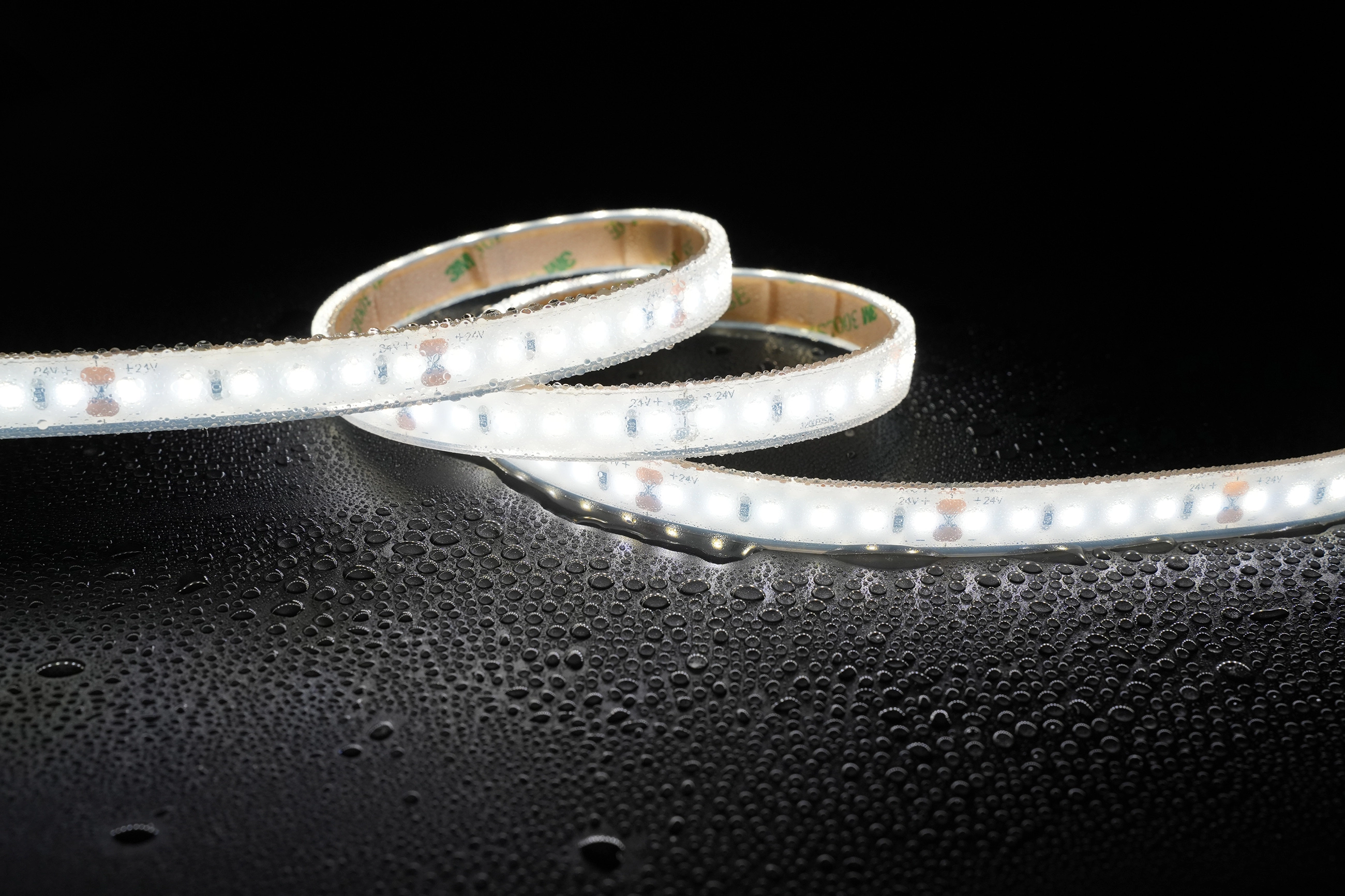
Waterproof performance is especially important for outdoor lighting, landscape projects, building facades, and installations exposed to moisture.
However, an IP rating alone does not tell you everything about a product's suitability. The strip's construction, connectors, cable entries, installation method, and environmental exposure also matter.
For example, an LED strip installed inside a dry retail display may have very different requirements from one used along an outdoor building facade. An underwater installation requires even more careful consideration of the complete product assembly and its specified operating conditions.
Before ordering, confirm:
The required IP rating for the intended application.
Whether the rating applies to the complete assembly or only a particular component.
The recommended installation method and compatible accessories.
The operating temperature range and environmental limitations.
Whether supporting test reports are available for the exact model.
For demanding projects, ask the factory to explain how waterproof performance is achieved and verified during production. This is more useful than relying solely on a specification sheet or a general marketing claim.
Quanhe Lighting focuses on improvements in waterproof performance, materials, and lighting technology. Its range of flexible LED strip lights, neon flex, and flexible wall washers can serve different project requirements, provided the selected model is matched to the actual installation conditions.
Bulk orders require more than good products. The factory must also be able to manufacture the required quantity within an agreed schedule.
A supplier may produce excellent samples but struggle with larger orders if its production lines, component supply, workforce, or quality inspection capacity are insufficient.
Before confirming an order, discuss the following points:
Standard production lead time and current production workload.
Minimum order quantities for standard and customized products.
Availability of critical components and backup sourcing arrangements.
Production planning for repeat orders.
Inspection schedules and shipment preparation.
Procedures for handling delays or changes in order quantities.
Ask the supplier to confirm the delivery schedule in writing. For projects with multiple installation stages, it may be useful to discuss whether production and shipment can be coordinated with the project timeline.
Standardized production lines can help a factory maintain repeatability, but capacity should still be assessed against the specific order. A manufacturer that can produce one model efficiently may require additional preparation time for customized lengths, special connectors, or different waterproof constructions.
If your business expects recurring orders, discuss how the factory will maintain the same product specifications between batches. Keeping approved samples, technical drawings, and written product requirements can reduce the risk of unexpected changes.
Different markets and projects often require different LED strip specifications. These may include voltage, power consumption, LED density, color temperature, color rendering, dimming compatibility, cutting intervals, and mounting accessories.
A capable factory should be able to explain which options are available and which changes require a customized design.
Technical support is equally important. If a lighting contractor encounters uneven illumination, installation difficulties, or compatibility issues, clear guidance from the manufacturer can help resolve the problem more efficiently.
When discussing customization, provide a written specification rather than relying on informal descriptions. Include installation drawings, operating conditions, required lighting effects, and any applicable certification requirements.
Quanhe Lighting provides customized lighting solutions alongside its standard product range. Its experience with high-end linear lighting can be relevant to projects involving architectural details, hospitality spaces, museums, landscape installations, and residential decoration.
For buyers comparing suppliers, it is also useful to review the manufacturer's product catalog and technical resources. You can explore additional lighting information through the LED strip lighting manufacturer's website when evaluating product options and planning your sourcing requirements.
Documentation helps buyers verify product suitability and meet the requirements of their target markets.
Depending on the destination and application, relevant documentation may include electrical safety certifications, electromagnetic compatibility reports, RoHS documentation, product specifications, test reports, and installation instructions.
Do not assume that every product made by a factory holds every certification. Ask for documents that correspond to the exact model, configuration, and intended market. Verify their validity and scope where necessary.
You should also establish whether the supplier can provide consistent export documentation, packaging information, shipping marks, and product labels.
Clear communication is particularly important for overseas bulk orders. Confirm who will handle technical questions, order updates, inspection arrangements, and after-sales issues. A responsive contact who understands the product can make a meaningful difference when problems need to be resolved quickly.
Even after reviewing a factory's credentials, you should not skip sample evaluation. A sample provides a practical way to compare product performance with your requirements.
Whenever possible, request samples produced using the same materials and specifications proposed for mass production.
During evaluation, check:
Brightness and color consistency across the strip.
Soldering quality, PCB condition, and overall workmanship.
Cutting marks, connection points, and installation flexibility.
Compatibility with the intended power supply and dimming system.
Heat generation under the specified operating conditions.
Waterproof construction and supporting test documentation, if applicable.
For larger projects, consider testing several samples rather than relying on a single piece. You may also arrange a pre-shipment inspection based on agreed acceptance criteria.
Once the sample is approved, document the specifications and retain a reference sample if practical. This creates a clear benchmark for future production batches.
Choosing a reliable LED strip light factory in China for bulk orders requires a practical assessment of manufacturing experience, R&D capabilities, quality control, waterproof performance, production capacity, customization, and documentation.
The most suitable supplier is not necessarily the one with the broadest catalog. It is the factory that can consistently manufacture products matching your specifications, provide evidence of quality, communicate clearly, and support your business as order volumes grow.
Quanhe Lighting Co., Ltd. offers a relevant example of a specialized manufacturer, with a focus on high-end linear lighting, continued technical development, customized solutions, and multi-stage quality control.
Before making a final decision, define your technical requirements, compare qualified factories, test samples, and confirm the production and inspection arrangements in writing. These steps can help you build a more reliable supply chain and reduce avoidable problems with bulk LED strip light orders.
Please provide the following detailed information so that our business representatives can better understand your needs and get in touch with you as soon as possible.


 EN
EN
 English